Comprehensive Montessori Grammar Lesson Plan for Ages 5-7

Introduction to Montessori Grammar
Montessori education introduces grammar in a concrete, hands-on manner, allowing children to physically manipulate symbols and words to understand their function within a sentence. This approach moves from the concrete to the abstract, fostering a deep, intuitive understanding of language structure rather than rote memorization. The curriculum employs a spiral approach, revisiting concepts with increasing complexity as the child develops .
Target Age Group
This lesson plan is designed for homeschool students aged 5-7 years old, encompassing Kindergarten, 1st, and 2nd grade. At this stage, children are typically transitioning from concrete thinking to more abstract reasoning, making the Montessori grammar symbols an ideal tool for understanding sentence construction.
Materials Needed
To implement this lesson plan effectively, the following materials are recommended:
•Montessori Grammar Symbols: A set of the nine grammar symbols (Noun, Article, Adjective, Verb, Adverb, Pronoun, Preposition, Conjunction, Interjection). The generated image /home/ubuntu/montessori_grammar_symbols.png can be used as a control card or reference.
•Sentence Strips: Pre-written sentences on strips of paper, or blank strips for children to write their own sentences.
•Word Cards: Individual words written on small cards, categorized by part of speech (e.g., a basket of noun cards, a basket of verb cards).
•Small Objects/Miniatures: A collection of small, tangible objects (e.g., a toy car, a small ball, a miniature animal) for the initial concrete introduction of nouns and verbs.
•Pencils and Paper/Notebook: For writing and sentence construction.
•Control Charts/Answer Keys: For self-correction (optional, but encouraged in Montessori).
•Object Baskets: Themed baskets with 3-5 objects for vocabulary and initial grammar lessons.
•Sandpaper Letters: For tactile introduction to letter shapes and sounds.
•Moveable Alphabet: For composing words and sentences before the hand is ready for writing.
The 9 Parts of Speech and Their Symbols
Montessori grammar uses distinct geometric symbols, each with a specific color, to represent the nine parts of speech. These symbols provide a visual and tactile representation of the function of each word in a sentence.
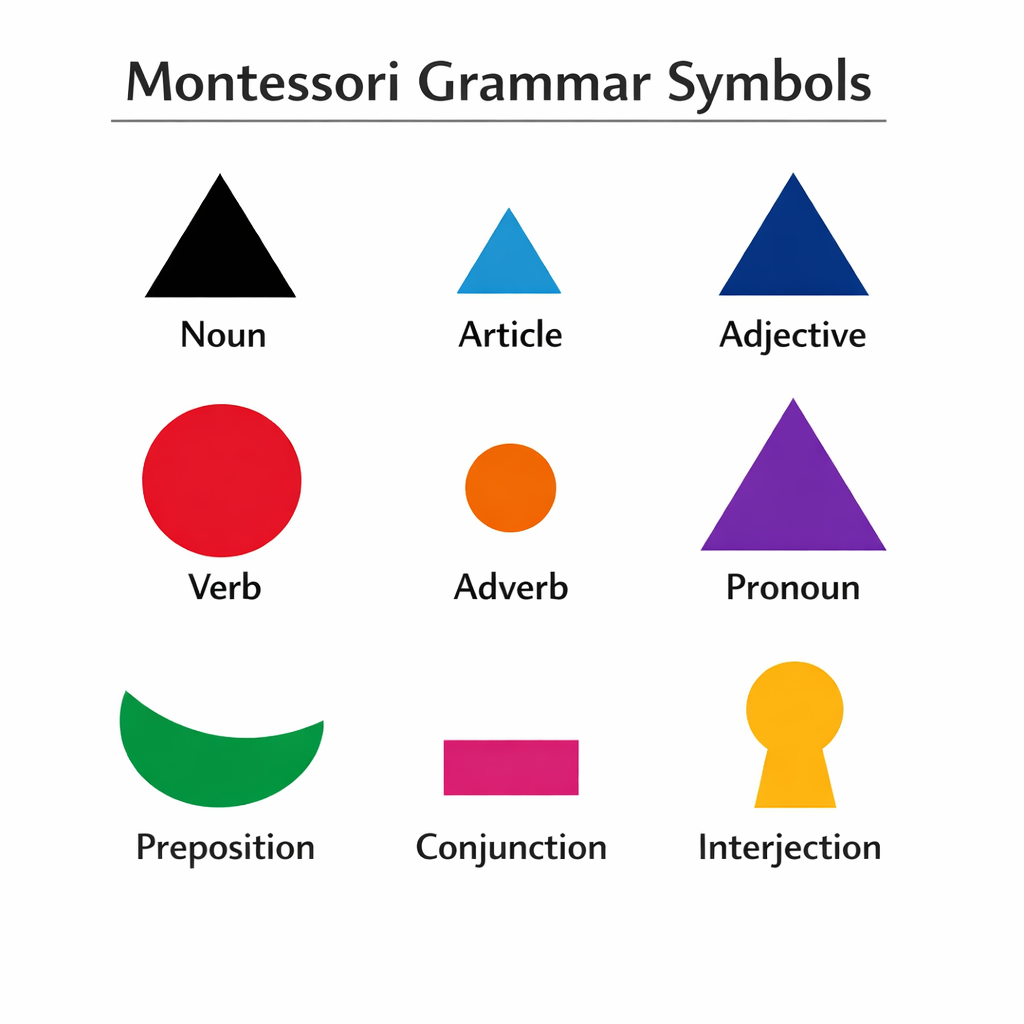
Part of Speech | Symbol | Color | Description |
Noun | Large Triangle | Black | Names a person, place, thing, or idea. |
Article | Small Triangle | Light Blue | Precedes a noun (a, an, the). |
Adjective | Medium Triangle | Dark Blue | Describes a noun. |
Verb | Large Circle | Red | Shows action or a state of being. |
Adverb | Small Circle | Orange | Describes a verb, adjective, or another adverb. |
Pronoun | Isosceles Triangle | Purple | Replaces a noun. |
Preposition | Crescent | Green | Shows relationship between a noun/pronoun and another word. |
Conjunction | Rectangle | Pink | Joins words, phrases, or clauses. |
Interjection | Keyhole | Gold/Yellow | Expresses strong emotion. |

Lesson Activities: Reading, Grammar, and Writing
This section outlines a progressive series of activities, starting with concrete introductions and moving towards abstract understanding and application. The Three-Period Lesson is integrated throughout, providing a structured approach for introducing new concepts.
The Three-Period Lesson: A Foundation for Learning
The Three-Period Lesson, designed by Édouard Séguin and refined by Maria Montessori, is a fundamental framework for introducing new concepts, names, or rules. It separates the cognitive tasks of learning into three distinct periods: Naming, Recognizing, and Recalling .
•Period One: Naming (This is…): The adult presents the object or concept and names it. The child observes. No response is required from the child.
•Period Two: Recognizing (Show me…): The adult gives commands that the child can demonstrate without needing language. The child shows understanding through action.
•Period Three: Recalling (What is this?): Only when the child shows complete confidence in Period Two does the adult ask the child to retrieve the name. If the child errs, the adult warmly returns to Period One without correction.
Phase 1: Concrete Introduction (Ages 5-6)
Objective: To introduce the concept of nouns and verbs through tangible experiences using the Three-Period Lesson.
Activity: The Noun and Verb Object Basket
1.Preparation: Select an object basket with 3-5 distinct objects (e.g., a car, a ball, a flower). Have the black triangle (noun) and red circle (verb) symbols ready.
2.Period One (Naming - Noun): Place an object (e.g., car) on the mat. Say, "This is a car. Car is a noun." Place the black triangle above the object. Repeat for other objects. The child observes.
3.Period Two (Recognizing - Noun): Say, "Show me the ball." "Give me the flower." "Put the car here." The child points to or moves the objects. Continue until the child confidently identifies all nouns.
4.Period Three (Recalling - Noun): Point to an object and ask, "What is this?" If the child answers correctly, proceed. If not, return to Period One for that object. Once nouns are established, introduce verbs similarly.
5.Period One (Naming - Verb): Perform an action (e.g., walk). Say, "I am walking. Walk is a verb." Place the red circle next to yourself. Repeat for other actions (e.g., jump, run).
6.Period Two (Recognizing - Verb): Say, "Show me jump." "Do walk." The child performs the action. Continue until the child confidently demonstrates all verbs.
7.Period Three (Recalling - Verb): Perform an action and ask, "What am I doing?" or "What is this action?" If the child answers correctly, proceed. If not, return to Period One for that action.
8.Combining Nouns and Verbs: Once nouns and verbs are understood, combine them. Place an object and perform an action. Say, "The car rolls." Place the black triangle above "car" and the red circle above "rolls." Use sentence strips with simple noun-verb phrases and have the child match the symbols.
Phase 2: Introducing the Nine Symbols with Three-Period Lesson (Ages 6-7)
Objective: To introduce all nine parts of speech symbols and their functions using the Three-Period Lesson.
Activity: Grammar Symbol Introduction with Word Cards
1.Preparation: Have word cards for each part of speech and the corresponding grammar symbols. Start with 3-5 words for each new part of speech.
2.Introducing Each Part of Speech (e.g., Adjective):
•Period One (Naming): Show the dark blue triangle (Adjective symbol) and a word card (e.g., "big"). Say, "This is an adjective. This word is big." Explain that an adjective describes a noun. Repeat with other adjective word cards.
•Period Two (Recognizing): Lay out several word cards (including adjectives and other known parts of speech). Say, "Show me an adjective." "Point to the word that describes something." The child identifies the adjective word cards and places the dark blue triangle above them.
•Period Three (Recalling): Point to an adjective word card with its symbol and ask, "What is this part of speech?" If the child answers correctly, proceed. If not, return to Period One.
3.Repeat for all 9 Parts of Speech: Systematically introduce each of the nine grammar symbols using the Three-Period Lesson with appropriate word cards. Ensure the child has a solid grasp of each concept before moving to the next.
Phase 3: Advanced Sentence Analysis and Writing (Ages 7+)
Objective: To deepen understanding of sentence structure and apply grammar knowledge in writing, integrating the Moveable Alphabet and Sandpaper Letters.
Activity: Sentence Construction and Analysis with Moveable Alphabet
1.Preparation: Have the Moveable Alphabet ready. Provide sentence strips with sentences to analyze, or encourage the child to create their own.
2.Sentence Building: Ask the child to build a sentence using the Moveable Alphabet (e.g., "The cat sleeps."). This allows them to compose sentences before their fine motor skills are fully developed for writing.
3.Symbol Placement: Once the sentence is built, guide the child to place the corresponding grammar symbols above each word. For "The cat sleeps.":
•"The" (light blue triangle - Article)
•"cat" (black triangle - Noun)
•"sleeps" (red circle - Verb)
4.Three-Period Lesson for Sentence Analysis: For more complex sentences or when introducing new grammatical structures (e.g., phrases, clauses), use the Three-Period Lesson to help the child identify and understand the function of each part.
•Period One: Model analyzing a sentence, placing symbols and naming each part of speech. "This is the noun, cat." "This is the verb, sleeps."
•Period Two: Ask the child to analyze parts of a sentence. "Show me the adjective in this sentence." "Place the verb symbol above the action word."
•Period Three: Ask the child to identify parts of speech independently. "What is this word?" (pointing to a word in a sentence).
5.Writing Integration: After working with the Moveable Alphabet and symbols, transition to writing sentences on paper. Encourage the child to draw the symbols above their written words. For younger children, Sandpaper Letters can be used to reinforce letter formation and phonics as they write.
Activity: Creative Writing with Grammar Focus
1.Sentence Expansion with Symbols: Provide a simple sentence. Using the grammar symbols as prompts, ask the child to expand the sentence. For example, for "The bird sings.":
•"Can you add an adjective to describe the bird?" (e.g., "The little bird sings.")
•"How does the bird sing? Add an adverb." (e.g., "The little bird sings sweetly.")
•"Where does the bird sing? Add a prepositional phrase." (e.g., "The little bird sings sweetly in the tree.")
2.Story Writing with Grammar Awareness: Encourage the child to write short stories or paragraphs. As they write, prompt them to consciously use different parts of speech and place the symbols above their words. This reinforces their understanding and encourages varied sentence structure.
Assessment and Observation
In the Montessori approach, assessment is primarily through observation. Observe the child's engagement, understanding, and ability to apply the concepts. Look for:
•Accuracy: Is the child correctly identifying parts of speech and placing the symbols?
•Independence: Can the child work with the materials and analyze sentences with minimal guidance?
•Creativity: Is the child applying grammar concepts in their own writing?
•Problem-Solving: How does the child approach challenges or errors in sentence analysis?
•Application of Three-Period Lesson: Does the child demonstrate understanding at each stage of the Three-Period Lesson?
Conclusion
This comprehensive Montessori grammar lesson plan provides a structured yet flexible framework for teaching grammar to young children in a homeschool environment. By utilizing the concrete grammar symbols, integrating the Three-Period Lesson, and incorporating essential Montessori language materials like Object Baskets, Sandpaper Letters, and the Moveable Alphabet, children can develop a strong foundation in language arts. This approach fosters both reading comprehension and effective writing skills, preparing them for more advanced linguistic studies through a natural, hands-on, and engaging process.

.png)


No comments:
Post a Comment
Thank you!