The Monisorri Prepared Home: A One-Stop Guide to Montessori Preschool (Ages 3-5)

By Sean Taylor, Masters of Education
Designing a Montessori environment at home is not about recreating a classroom; it is about creating a "prepared environment" that respects the child’s burgeoning need for independence, order, and purposeful work. For parents of children aged three to five, the home is the ultimate laboratory for learning. This guide provides a comprehensive blueprint for setting up your home Montessori preschool, focusing on high-impact, low-cost strategies that prioritize the child's development over expensive retail catalogs.
The Philosophy of the Prepared Environment
In the Montessori method, the environment is often called the "third teacher." Every element — from the height of the shelves to the selection of materials — should communicate order, beauty, and belonging. For the 3-5 age group, the goal is to bridge the gap between home life and academic readiness through six core learning areas.
1. Practical Life: The Foundation of Independence
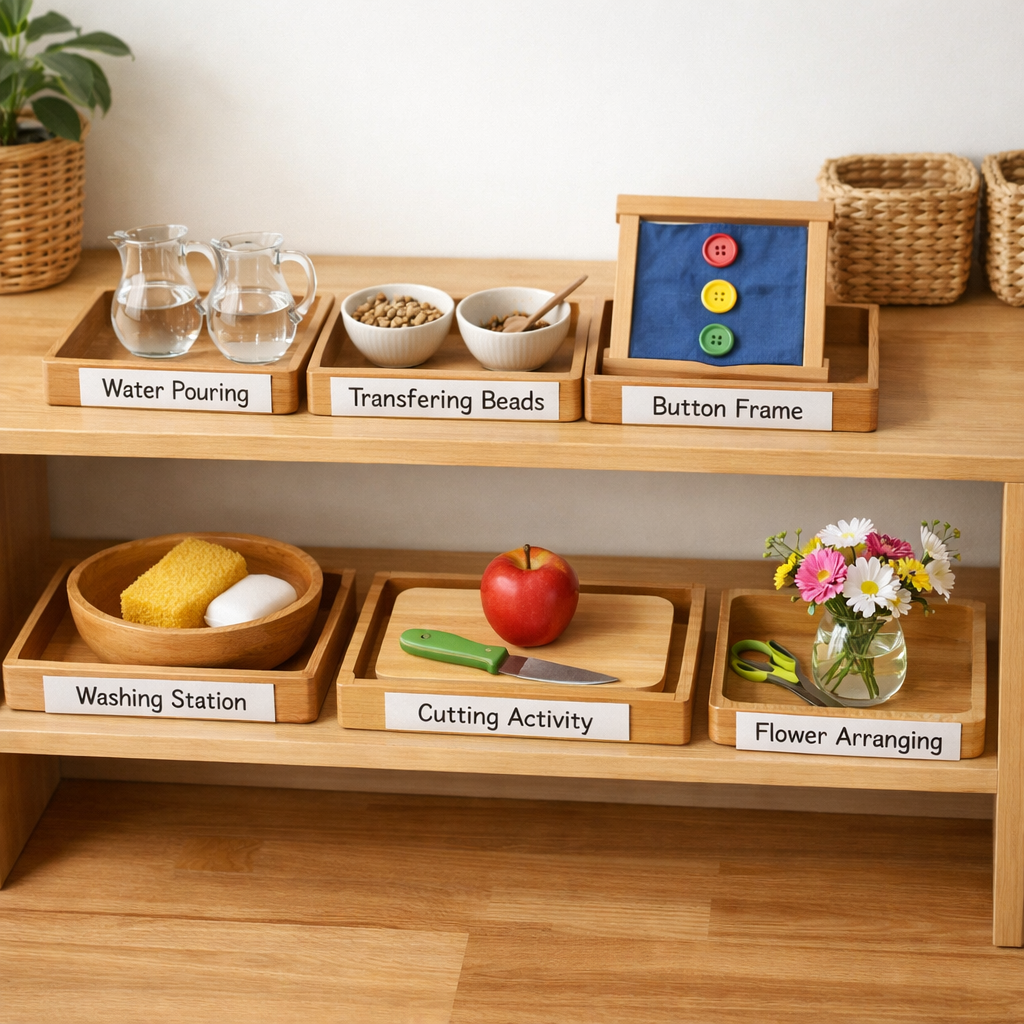
Practical Life is the most critical area for the preschool child. It builds concentration, fine motor control, and a sense of responsibility. These activities are often the most affordable to set up because they use real-world items.
| Item Category | Essential Materials | DIY / Budget Sourcing Tips |
| Pouring & Transferring | Small glass pitchers, ceramic bowls, spoons, tongs, funnels, trays. | Visit thrift stores for unique, small-scale creamers and ceramic dishes. Use dried beans or rice for transferring. |
| Self-Care | Dressing frames (buttons, zippers, snaps), small mirror, child-height hooks. | Use old clothing with fasteners and stretch them over embroidery hoops or wooden frames. |
| Care of Environment | Small basin, sponge, soap, drying rack, child-safe knife, cutting board. | Repurpose a small plastic or metal basin. Buy a "nylon" child-safe knife online for safe food prep. |
| Grace & Courtesy | Small vase for flower arranging, polishing cloths, mild beeswax. | Use a smooth river rock as a "Peace Stone" for turn-taking or conflict resolution. |
2. Sensorial: Refining the Senses
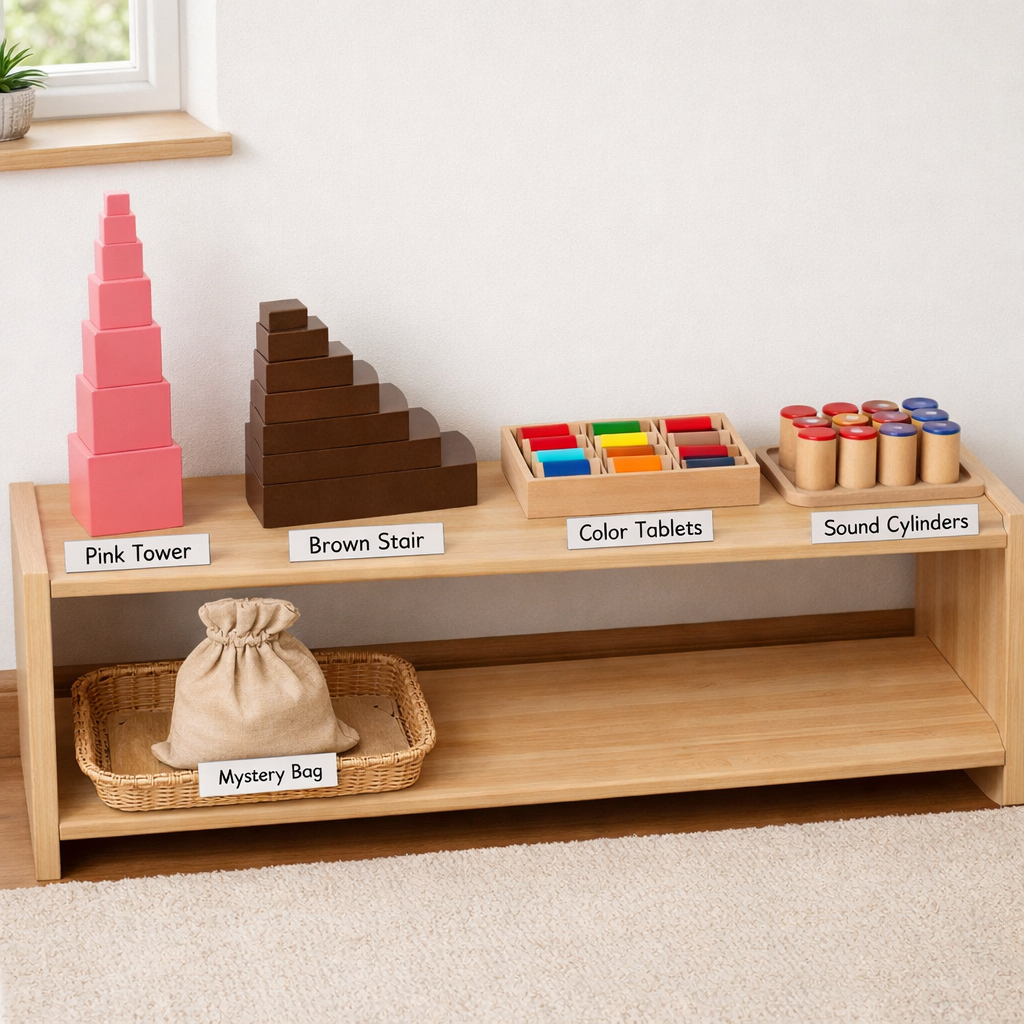
Sensorial materials help children organize and categorize their sensory experiences, which is a direct prerequisite for mathematical and language abstraction.
| Item Category | Essential Materials | DIY / Budget Sourcing Tips |
| Visual Discrimination | Pink Tower (cubes), Brown Stair (prisms), Color Tablets. | Look for second-hand sets on Facebook Marketplace or local Montessori community pages. |
| Auditory & Tactile | Sound cylinders, Fabric box (texture matching), Mystery Bag. | Fill identical spice jars with rice, sand, or bells for sound cylinders. Use fabric scraps for matching. |
| Baric & Stereognostic | Weighted cylinders, geometric solids. | Use a simple cloth bag filled with common household objects for the "Mystery Bag" activity. |
3. Language: From Concrete to Abstract
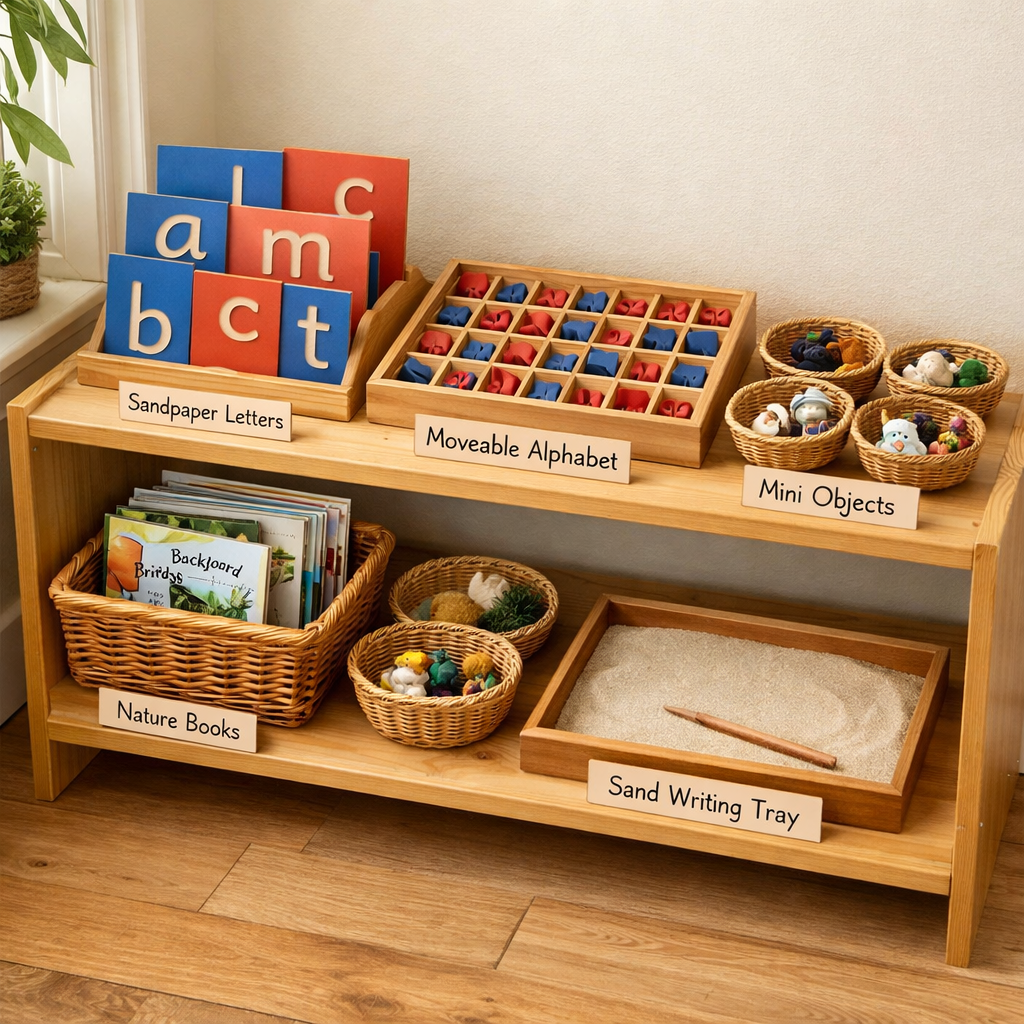
Montessori language work begins with tactile experiences. We prepare the hand for writing before we ask the child to read.
| Item Category | Essential Materials | DIY / Budget Sourcing Tips |
| Phonemic Awareness | Sandpaper Letters, Moveable Alphabet, Object Baskets. | Cut letters from sandpaper and glue to cardstock. Print and laminate a "Moveable Alphabet" set. |
| Vocabulary | Picture-to-object matching cards, nature books, poetry books. | Use small animal figurines (like Schleich or "Toob" sets) found at thrift stores for matching. |
| Writing Prep | Sand writing tray, metal insets (or stencils), chalkboard. | Use a shallow wooden tray filled with fine sand or salt for tracing letters. |
4. Mathematics: Concrete Quantity
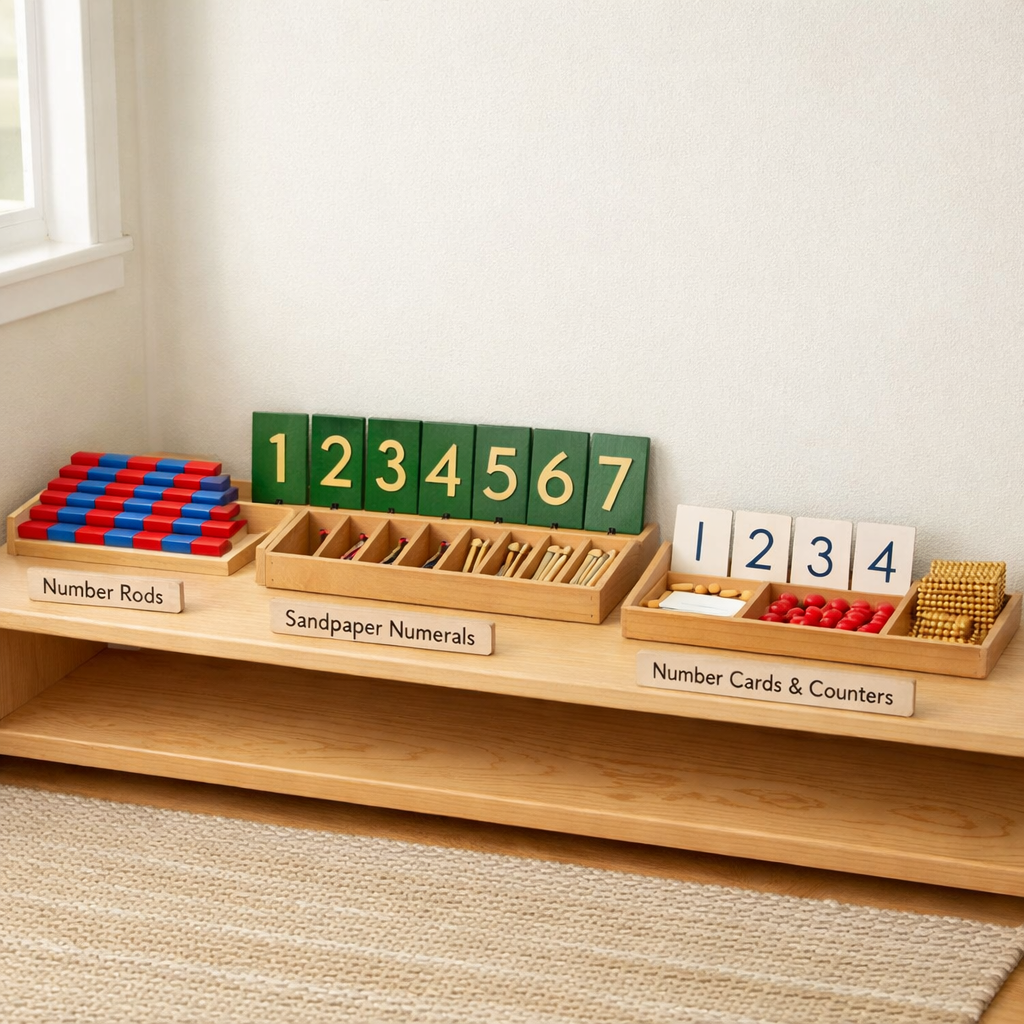
Mathematics is introduced through physical quantities. The child holds "ten" in their hands before they ever see the symbol "10."
| Item Category | Essential Materials | DIY / Budget Sourcing Tips |
| Numbers 1-10 | Number Rods, Sandpaper Numerals, Spindle Boxes. | Paint wooden dowels in alternating red and blue for Number Rods. Use egg cartons for Spindle Boxes. |
| Decimal System | Golden Bead Material (units, tens, hundreds), Number Cards. | Use gold-colored plastic beads or even yellow pony beads on wire for DIY Golden Beads. |
| Counting & Order | Counters and cards (odd/even), sorting trays. | Use buttons, smooth stones, or seashells as counters. |
5. Cultural & Science: Exploring the World
This area encompasses Geography, Botany, Zoology, and History, fostering a sense of wonder about the natural world.
| Item Category | Essential Materials | DIY / Budget Sourcing Tips |
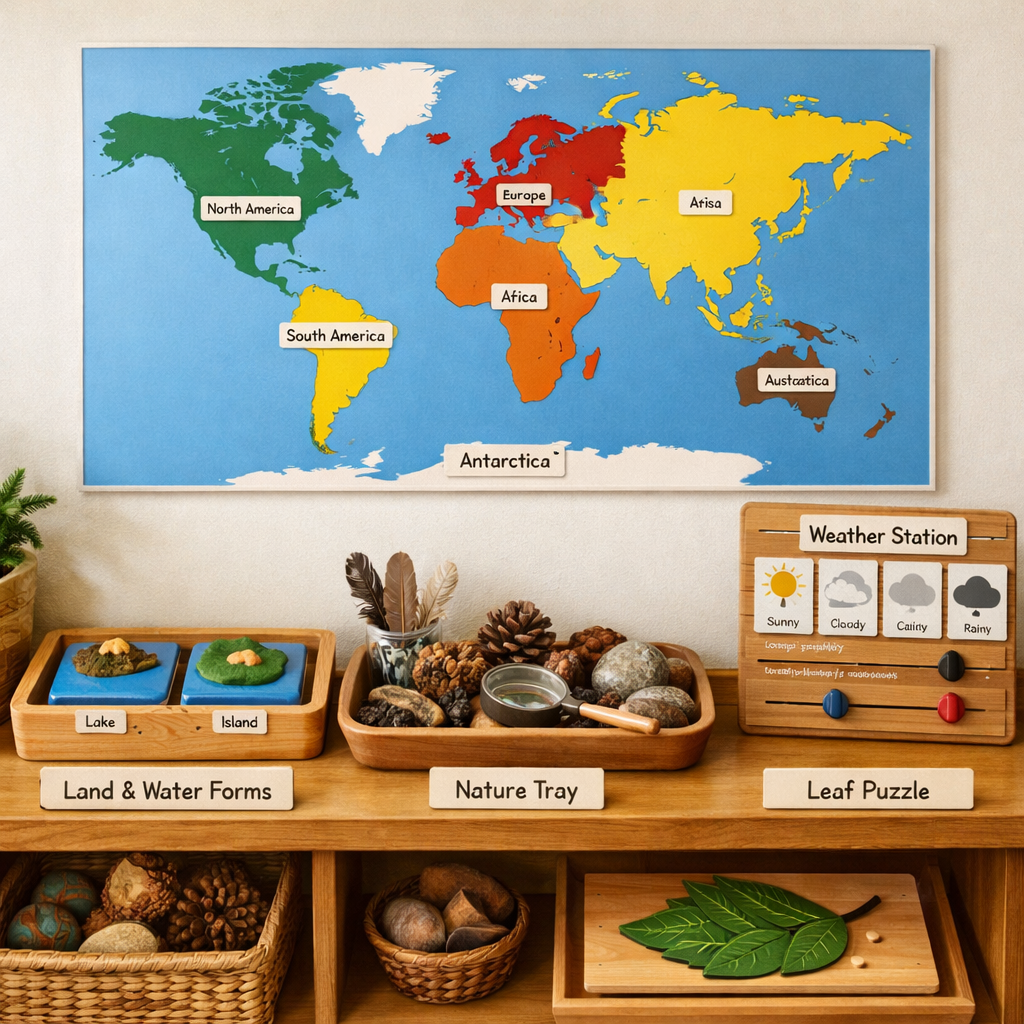
| Geography | Color-coded World Map, Land/Water form trays. | Print maps and color-code the continents. Use blue and brown playdough for land/water forms. |
| Science & Nature | Nature tray, magnifying glass, magnets, weather station. | Create a "Nature Tray" with items found on walks (cones, rocks, leaves). |
| Botany & Zoology | Leaf/Animal puzzles, classification charts. | Use free printable charts and laminate them. Create "Life Cycle" cards using printed photos. |
6. The Peace Corner & Creative Arts
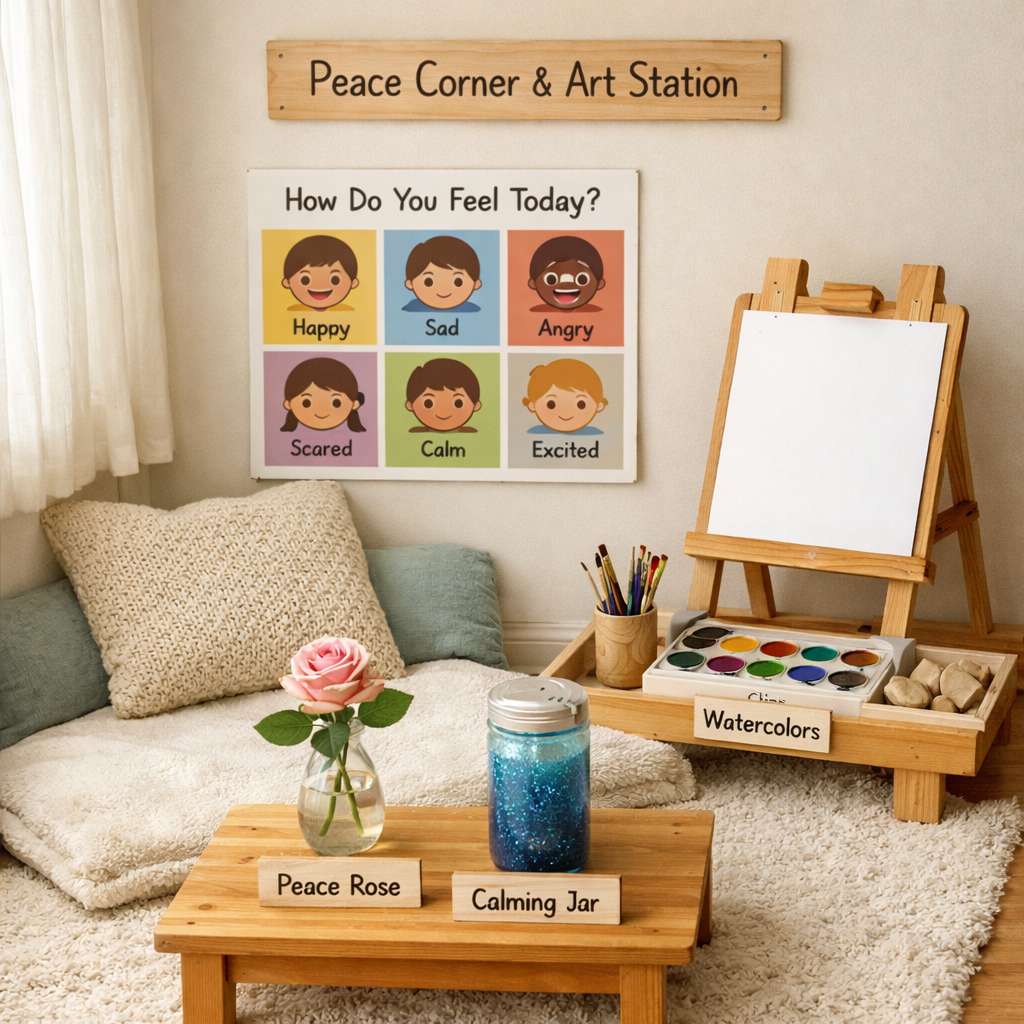
A Montessori home should have a dedicated space for emotional regulation and creative expression.
| Item Category | Essential Materials | DIY / Budget Sourcing Tips |
| Emotional Peace | Soft cushion, Peace Rose, Calming Jar, Feelings Chart. | Make a "Calming Jar" with water, glitter, and glue. Print a simple "How do I feel?" chart. |
| Art & Music | Easel, watercolors, clay, rhythm instruments. | Thrifted trays and jars are perfect for organizing art supplies. Use a small drum or shaker for music. |
The Master Shopping & Sourcing List
To set up your home Montessori preschool on a budget, prioritize the Critical Items and DIY the rest.
Critical Items (Worth the Investment)
•Low, Open Shelving: IKEA Kallax or similar units are the gold standard for accessibility.
•Work Mats: Small, solid-colored rugs (IKEA or thrifted) to define the child's workspace.
•Pink Tower: This is difficult to DIY accurately and is a foundational sensorial material.
•Sandpaper Letters: High-quality tactile feedback is essential for early writing.
Where to Buy at a Reduced Price
1.Facebook Marketplace & Buy Nothing Groups: Search for "Montessori" or "Wooden Toys." Many families sell materials as their children outgrow them.
2.Thrift Stores (Savers, Goodwill): Excellent for "Practical Life" items like small pitchers, trays, baskets, and ceramic bowls.
3.Community Pages: Join local Montessori homeschooling groups for "swap and sell" events.
4.Discount Online Retailers: Check Adena Montessori or Alison's Montessori for prices that are often lower than Amazon.
The "Can-Make-Myself" List
•Spindle Boxes: Use a painted egg carton and craft sticks.
•Mystery Bag: Any drawstring cloth bag with household objects.
•Sound Cylinders: Identical spice jars filled with different materials.
•Number Rods: Wooden dowels from a hardware store painted red and blue.
•Nature Tray: A simple wooden tray filled with treasures from your backyard.
Final Layout Suggestions
•Keep it Sparse: Only 3-5 works per shelf. Clutter is the enemy of concentration.
•Left-to-Right: Arrange works from simplest to most complex, following the natural reading order.
•Eye-Level Art: Hang beautiful, realistic art at the child's eye level, not yours.
•Define Spaces: Use work mats to ensure the child has a clear, undisturbed area for their "work."
By focusing on these six stations and utilizing affordable sourcing, you can create a world-class Montessori environment that nurtures your child's natural desire to learn and grow.


No comments:
Post a Comment
Thank you!